Amy Ferron lives and works on Lopez Island in Washington's San Juan Islands. She is a master quilter who came to painting through the spatial logic of fabric — the management of positive and negative, the deliberate play of light against dark, the hard seam edge as a compositional tool. That quilter’s vocabulary translated directly into her painting practice, where she first paints or prints a background then applies layers of handmade paper, hand-painted paper, purchased papers, and maps, cutting with scissors, rotary cutters, and X-acto knives to build landscapes and garden scenes that have no pretense of direct observation. The result is a world constructed from the studio, not discovered in the field.
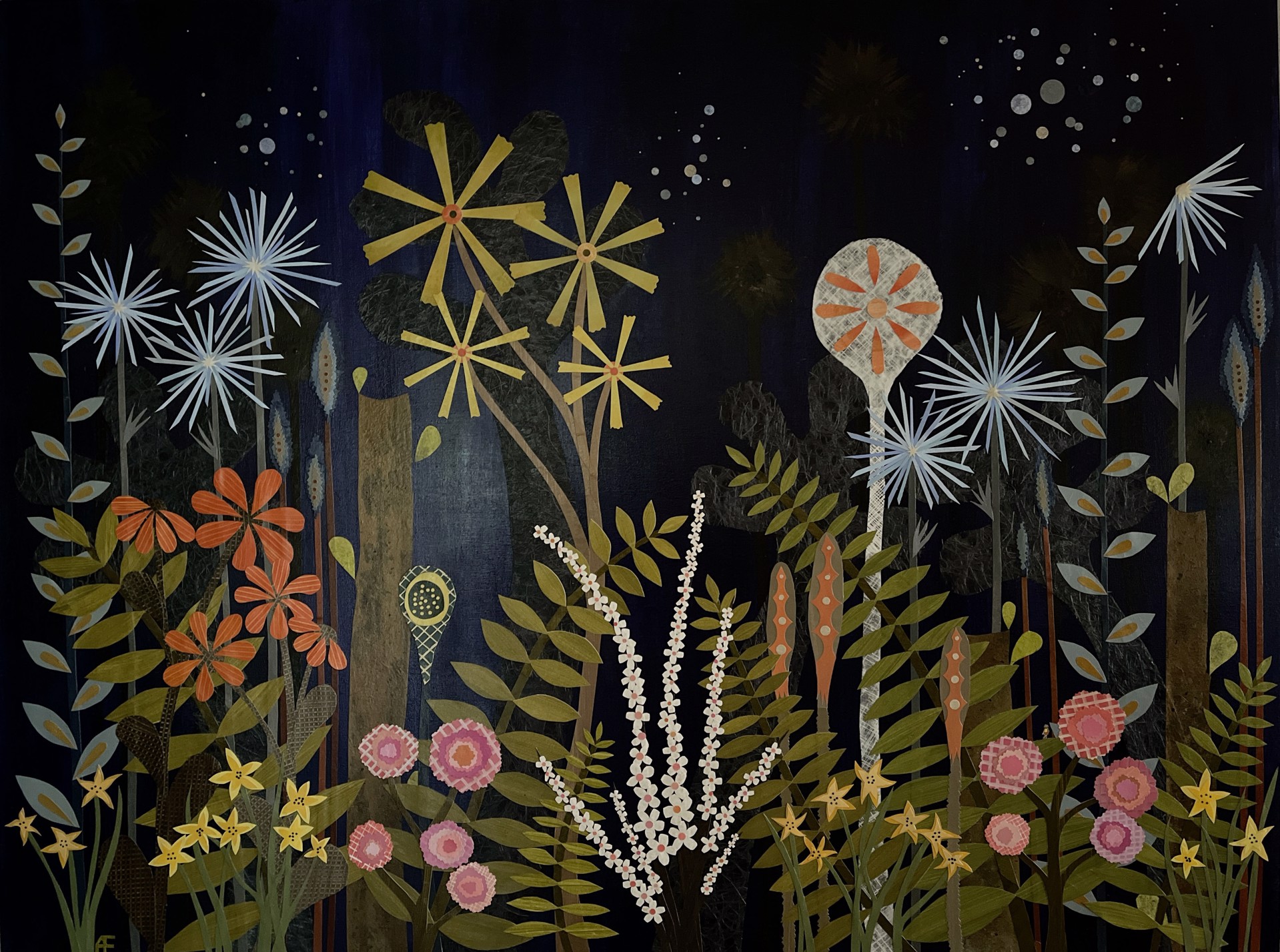
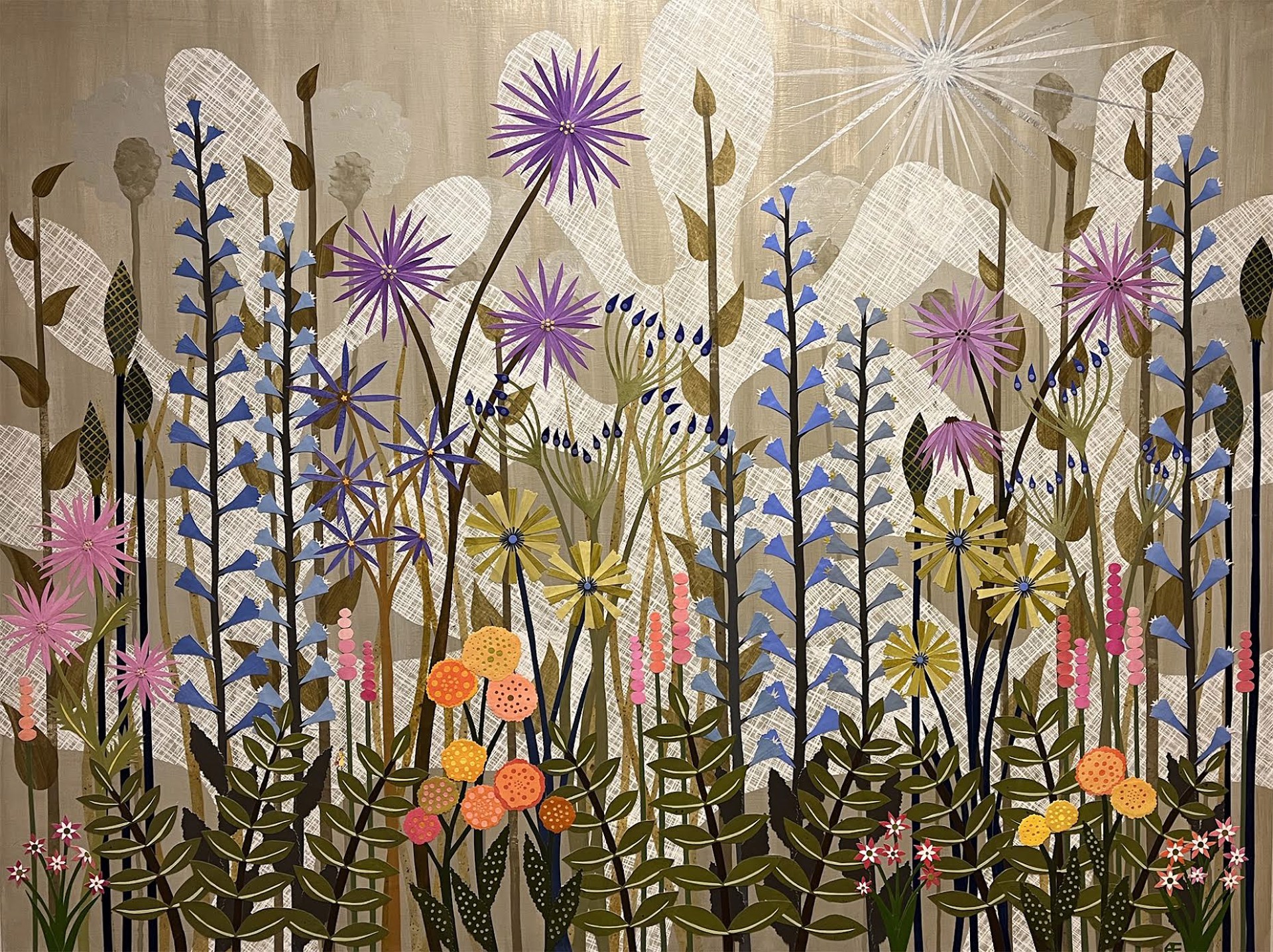
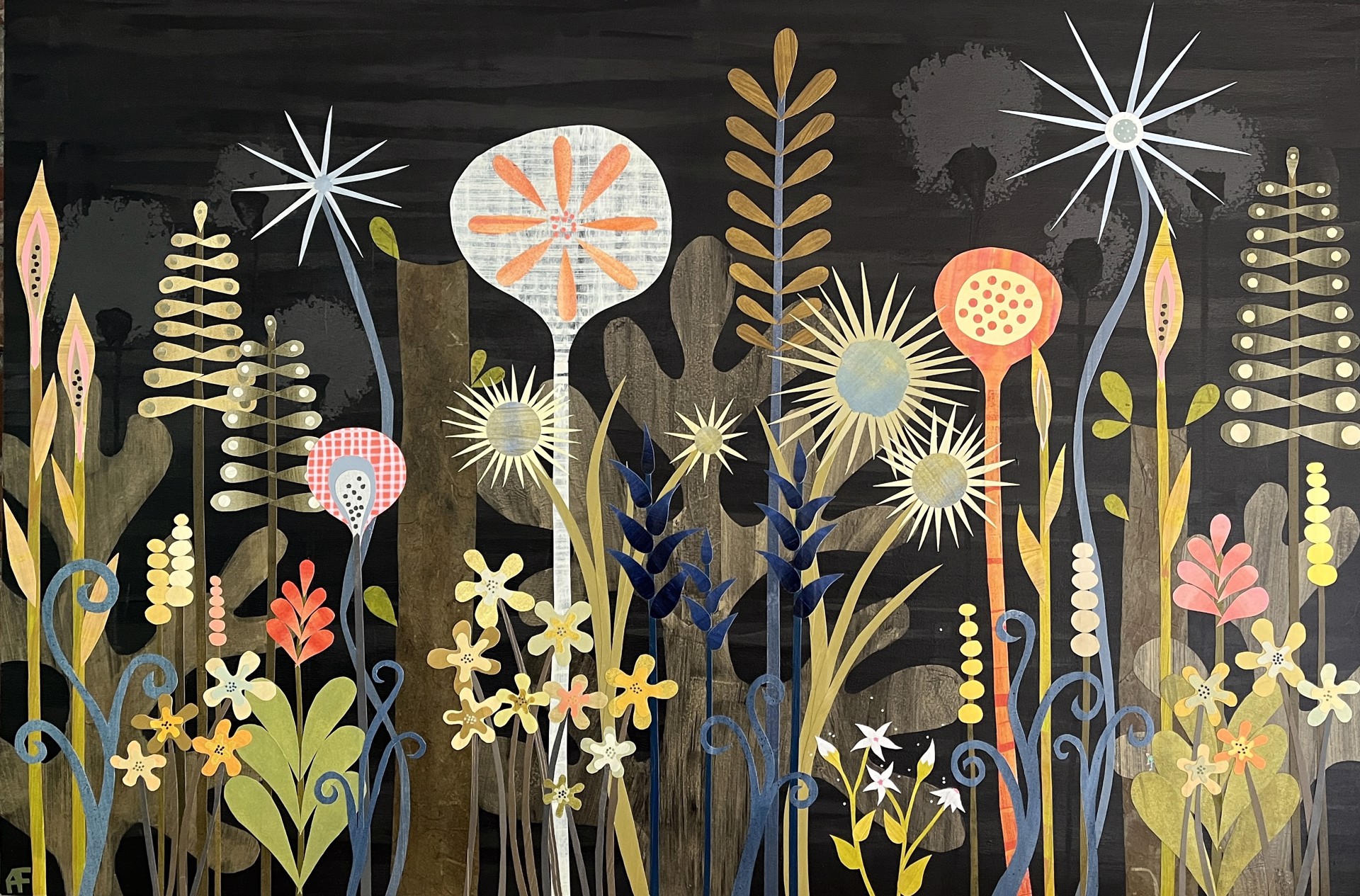
The lineage she claims — Henri Rousseau and Rex Ray — is precise and telling. Rousseau’s flat planes of saturated color, his imagined botanical worlds assembled from zoo visits and Paris gardens rather than actual jungle, his refusal of academic perspective in favor of decorative frontality: these are operating principles in Ferron’s work, not just passing influences. Rex Ray brought a second current — the hard-edged painted-paper collage tradition that ran through mid-century modernism, Dada, and Pop, landing in SFMOMA’s collection and earning comparisons to Klee and Matisse for its deceptively simple chromatic organization. Ferron works in that zone between flat pattern and landscape, between the quilt and the painting. In The Night Embraces Everything, The composition organizes itself in strict horizontal bands—a deep indigo-black sky studded with silver circles above a dense botanical underworld rendered in olive, rust, and cream—where crisp paper edges create sharp demarcations between the layered silhouettes of cacti, ferns, and geometric flowers. Ferron works the collage surface with disciplined restraint, allowing negative space around central motifs (the white-bead branching form, the orange-centered dandelion) to anchor the eye while smaller elements cluster at the bottom in graduated density. The technique depends on the tension between painted grounds (which establish atmospheric perspective) and applied cut shapes (which insist on flatness), a dialogue that succeeds most when the work resists becoming mere pattern. The piece achieves genuine spatial complexity in its middle register but falters when the proliferation of decorative elements toward the base begins to feel more illustrative than composed—the small pink flowers and golden stars accumulate rather than build architectural weight, diluting the formal rigor that distinguishes the upper half. In The Earth Laughs Flowers, Ferron's layered cut-paper collage builds depth through overlapping planes of hand-painted paper—purples and yellows read forward while olive and tan recede—with crisp scissor edges creating a rhythmic fence of botanical forms across a neutral ground. The composition achieves compositional density through radical verticality: tall spike flowers and columnar stems establish a dense thicket punctuated by circular blooms in orange, pink, and gold that sit lower in the picture plane. Yet the regularity of stem placement and the decorative evenness of the palette occasionally flatten spatial recession; the work risks becoming pattern rather than landscape, where individual botanical character submits to overall design harmony. In At Night We Believe, The composition establishes depth through a dark charcoal ground that recedes behind an assertive foreground of layered cut-paper forms—delicate geometric flowers with radiating spines, feathered leaves, and segmented stems in cream, gold, coral, and navy blue. Sharp edges define each botanical element with graphic precision, while the interplay between opaque painted passages and translucent paper creates a shallow but active spatial plane where foreground blooms advance against the shadowed middle ground. The artist achieves a densely populated garden through repetition and scale variation, yet the work risks a decorative flatness: despite the sophisticated color choices and careful cutting, the composition lacks the psychological tension or spatial ambiguity that transforms ornament into genuine visual argument. The recurring nocturnal titles — moonlight, silver sun, invisible, night, stars — establish a consistent atmospheric register: these are dusk worlds, gardens at the edge of dark.
Her work has been exhibited at the Whatcom Museum in Bellingham, the Cascadia Art Museum in Edmonds, the Washington State Convention Center, Seattle City Hall, the Kirkland Arts Center, Ryan James Fine Arts, and the Anacortes Arts Festival. She has also shown at the Lopez Island Library and participates in the annual Lopez Island Artists’ Studio Tour. Harris Harvey Gallery in Seattle has represented her work.
Each object in nature is individual and unique. I look at grasses, flowers, and seaweeds — capturing their beauty and combining them in a unique and playful world. Amy’s decades as a master quilter inform her painting style, translating from fabric into paint and collage the artful play of papers that she uses to define space with light and dark.