Britt Freda holds a double degree with honors in fine art and writing from St. Lawrence University. She studied at the Lorenzo de’ Medici Institute in Florence and, by invitation, at La Cipressaia in Montepulciano, Italy under artists Rose Shakinovsky and Claire Gavronsky. The European training is present in her work: the formal relationship between figure and ground, the drawing discipline beneath the painted surface, the gold leaf — all carry the weight of a practice formed in dialogue with centuries of Western image-making. She lives on a small island in Puget Sound.
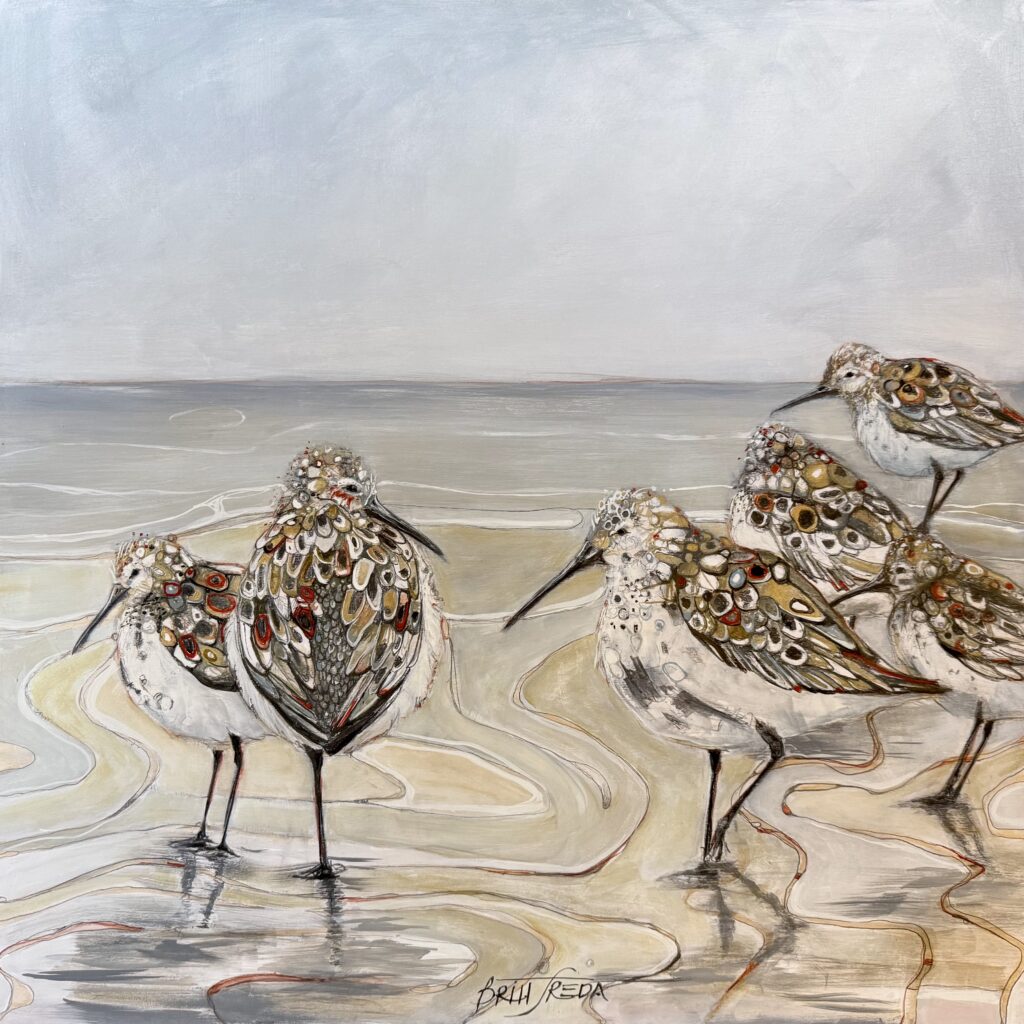
In Untitled, four shorebirds rendered in meticulous detail occupy the shallow foreground of this composition, their plumage articulated in burnt sienna, ochre, and cream against a beach of pale sand and graphite-gray water that recedes with deliberate flatness toward a milky horizon. The artist's brushwork vacillates between tight representational precision in the birds' intricate feather patterns and loose, gestural swirls in the wet sand below, creating a productive visual tension between control and spontaneity. The low vantage point and shallow spatial recession suggest observation from water level itself, yet the ornithological specificity—likely sandpipers or plovers—undercuts any romantic communion with nature, instead presenting these creatures as specimens worthy of scientific regard. Since 2011 her subject has been endangered species. Each work is built on paper — watercolor, ink, graphite, and gold leaf applied in layers, the surface embedded with etched words, statistics, poems, maps, and seedpods. The embedded material is not decoration: the population data, the poetic text, the map fragments locating the animal in its remaining range are part of the work’s argument. The painting makes the case for the animal not just visually but informationally. Her work is in the permanent collection of the National Museum of Wildlife Art in Jackson Hole.
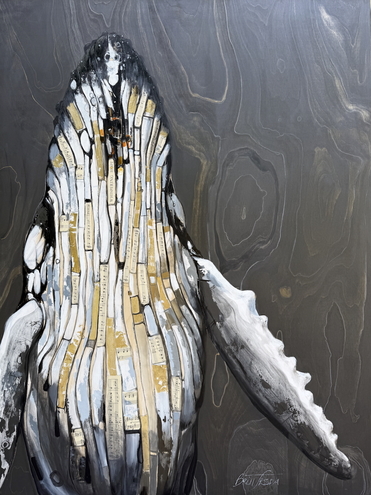
At JG, six works span from small intimate pieces at to the commanding The Kiss (Geoduck Shells) at — a large-format work that demonstrates the full complexity of her layered surface. The gold leaf catches light differently than the watercolor beside it. The etched text is visible at close range. The whole composition requires time to absorb. These are not decorative works. They are arguments, made in the most patient and considered medium available.
Gold leaf in painting is not decoration in the sense of being ornamental without function. It changes the light relationship of everything around it. It makes demands on what it touches.